3D Modeling Icon Set
In an era where visual communication dictates engagement, the difference between a cluttered interface and a polished user experience often comes down to small details. One of those critical details is the iconography. For designers, developers, and content creators working in digital spaces, finding assets that are both aesthetically pleasing and technically versatile can be a significant bottleneck. This is where a specialized 3D Modeling Icon Set becomes more than just a decorative element; it serves as a foundational tool for clarity and modern design.
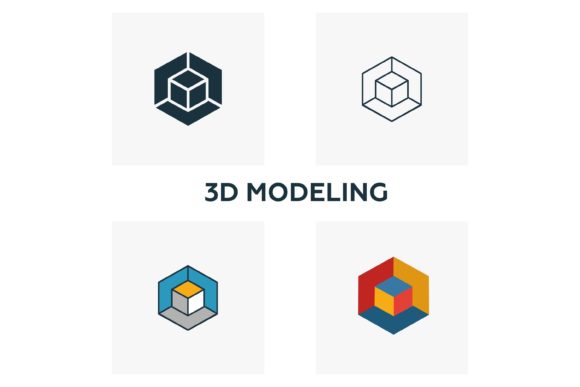
The specific collection we are examining offers four distinct elements rendered in different styles: filled, outline, colored, and flat symbols. These are not merely generic shapes but creative 3D modeling icons designed with UI and UX principles in mind. By providing these assets in both EPS and JPG formats, the package ensures that whether you need scalable vector graphics for logo work or ready-to-use raster images for quick deployment, you have the right tool for the job. Understanding how to leverage this variety can transform how you present complex data, guide users through interfaces, or brand your digital products.
Bridging Depth and Clarity in Digital Design
Three-dimensional representation in two-dimensional space has become a dominant trend in contemporary web and app design. It adds a layer of depth that captures attention without requiring heavy loading times associated with full 3D scenes. A well-executed 3D Modeling Icon Set leverages this trend to create visual interest while maintaining the functional requirements of user interface design. When a user encounters a dashboard, a portfolio site, or an educational platform, the icons they see act as cognitive shortcuts. They signal function before the text is even read.
The value of having four distinct styles—filled, outline, colored, and flat—lies in adaptability. In any given project, consistency is key, but so is hierarchy. A filled style might be used for primary actions, drawing the eye immediately, while an outline style could denote secondary features, creating a visual rhythm that guides the user’s journey. The colored variant adds emotional resonance or categorical distinction, whereas the flat symbol provides a minimalist backdrop when simplicity is paramount. This flexibility allows designers to maintain a cohesive brand voice across various touchpoints without being restricted by a single aesthetic constraint.
Practical Applications Across Industries
The utility of these creative 3D modeling icons extends far beyond simple decoration. Let us look at how different professionals might integrate these assets into their workflows to solve real-world problems.
- UI/UX Designers: For those crafting mobile applications or web platforms, the ability to switch between outline and filled states within the same set ensures that interactive elements (like buttons or tabs) can change state visually to indicate selection or hover effects. This micro-interaction feedback is crucial for intuitive navigation. The EPS files allow for precise scaling, ensuring that icons remain crisp on high-resolution displays.
- Marketing and Branding Professionals: When developing brand guidelines, consistency is vital. Having a unified set of 3D-style icons ensures that all marketing materials, from social media posts to email newsletters, share a common visual language. The colored versions can be easily adapted to match specific brand palettes, while the black-and-white outline options provide versatility for print materials or monochrome themes.
- Educators and Content Creators: Complex concepts often require simplified visual aids. Whether illustrating a point about cloud computing, data storage, or artificial intelligence, a clear 3D icon can communicate the idea faster than paragraphs of text. Bloggers and educators can use the JPG files directly in articles to break up dense text and improve readability, keeping learners engaged.
- Small Business Owners and Entrepreneurs: For startups launching MVPs (Minimum Viable Products), time is a scarce resource. Using a pre-made, high-quality icon set eliminates the need to commission custom illustrations for every feature. This accelerates the development cycle, allowing teams to focus on functionality and market fit rather than spending weeks on asset creation.
Technical Advantages of Vector and Raster Formats
A significant benefit of this particular package is the dual-format delivery. You receive both EPS and JPG files, each serving a unique purpose in the design pipeline. The EPS (Encapsulated PostScript) file is a vector format. This means it is resolution-independent. You can scale a 3D modeling icon from the size of a postage stamp to the width of a billboard without losing any sharpness or introducing pixelation. This is indispensable for logo design, large-scale signage, or responsive web design where the same icon must render perfectly on a smartwatch screen and a desktop monitor.
Conversely, the JPG files offer immediate usability. While vectors require software like Adobe Illustrator or Affinity Designer to edit, JPGs are universally compatible. They can be dragged and dropped into presentation software, basic graphic editors, or CMS platforms instantly. For freelancers who need to deliver quick mockups to clients, having the JPG version saves time. However, it is important to note that if you plan to heavily modify the color or shape of the icon later, the EPS file remains the superior choice due to its editable paths and layers.
Enhancing Communication Through Visual Hierarchy
One of the most overlooked aspects of design is visual hierarchy—the arrangement of elements to imply importance. A static list of features looks overwhelming. A list accompanied by relevant, stylized icons feels organized and approachable. The 3D Modeling Icon Set supports this by offering stylistic variations that can denote priority.
For instance, imagine a SaaS product landing page. The primary call-to-action might be accompanied by a bold, filled 3D icon to signify strength and immediacy. Secondary benefits could use the outline style, suggesting support rather than dominance. Tertiary information might use the flat style, receding slightly into the background. This subtle differentiation helps users scan information efficiently, reducing cognitive load. In a crowded digital marketplace, reducing friction for the user is a competitive advantage. Clearer communication leads to higher conversion rates, better user retention, and fewer support queries regarding how to use a product.
Considerations for Implementation
While the benefits are clear, successful integration requires thoughtful consideration. Not every context demands 3D aesthetics. In highly technical documentation or accessibility-focused designs, overly decorative icons can sometimes obscure meaning. Screen readers do not interpret visual styles, so alt-text remains critical regardless of how beautiful the icon is. Furthermore, while the set includes colored variants, ensure that the colors chosen maintain sufficient contrast against backgrounds to meet accessibility standards (WCAG).
Additionally, while the EPS files are easy to edit, they still require appropriate software. If your workflow relies solely on browser-based tools that only accept SVG or PNG, you may need to export your edited EPS files into those formats. The inclusion of JPG files mitigates this somewhat, but for maximum flexibility, familiarity with vector editing basics is recommended. It is also wise to compare this set with others in the market to ensure the specific "vibe" of the 3D rendering matches your brand identity. Some 3D styles are glossy and playful, while others are matte and corporate. This set appears to balance creativity with professional utility, making it a safe bet for a wide range of industries.
Conclusion on Utility and Impact
The decision to incorporate a 3D Modeling Icon Set into your design toolkit is ultimately about investing in clarity and efficiency. By providing four distinct styles in versatile formats, this collection addresses the diverse needs of modern digital production. It supports the creation of intuitive interfaces, enhances brand storytelling, and streamlines the workflow for creators across multiple disciplines. Whether you are refining the UX of a new app, designing a marketing campaign, or building an educational resource, the right visual assets can make the difference between confusion and comprehension. Embracing these tools allows you to focus less on the mechanics of asset creation and more on the strategic impact of your communication.